
ℹ️ Introduction
This article explains how to use Ardens Manager to support cardiovascular risk stratification using QRISK3 Predicted and Recorded scores. By the end of this article, you will be able to identify patients at increased cardiovascular risk, understand the difference between predicted and recorded scores, and use this information to support proactive care planning and preventative health initiatives.
Background
QRISK3 is a validated cardiovascular risk prediction algorithm used in the UK to estimate an individual’s 10-year risk of developing cardiovascular disease (CVD).
It supports organisations to:
Identify patients at increased cardiovascular risk
Support preventative and proactive care planning
Prioritise patients for review and intervention
Inform cardiovascular prevention programmes
Support population health management and service planning
QRISK3 uses demographic, clinical, prescribing, and lifestyle information recorded within the patient record to estimate future cardiovascular risk.
QRISK3 information within Ardens Manager is intended to support population health management and prioritisation rather than replace individual clinical assessment or clinical judgement.
How Ardens Can Help
Ardens Manager provides QRISK3 Predicted and Recorded risk stratification within the Population Dashboard, allowing you to review cardiovascular risk across your population and apply risk filters across reports.
QRISK3 (Predicted):
Applies the QRISK3 algorithm using available coded clinical data
Estimates cardiovascular risk where no recent recorded QRISK score exists
Supports population-level risk stratification and prioritisation
May rely on assumptions where data items are missing
Should not be used as a substitute for a formal clinical QRISK assessment
Predicted scores are designed to support proactive care planning and case finding activity rather than direct clinical decision-making.
QRISK2/3 (Recorded):
Uses an existing coded QRISK2 or QRISK3 score recorded within the clinical system
Reflects a clinician-confirmed cardiovascular risk assessment
Is typically based on complete and contemporaneous clinical information
Supports validated clinical review and management decisions
Using QRISK3 within Ardens Manager enables you to:
Identify patients at increased cardiovascular risk
Distinguish between predicted and clinician-recorded QRISK scores
Apply QRISK3 filters across all Ardens Manager reports
Combine cardiovascular risk with existing clinical cohorts
Support preventative care planning and proactive review activity
Inform service planning and cardiovascular prevention initiatives
QRISK3 is also available as a filter within all report breakdowns, allowing further stratification of any cohort.
✅Included in Ardens Manager National Content package: Interested in finding out more or requesting a trial? Contact accounts@ardens.org.uk
📍Access QRISK3®
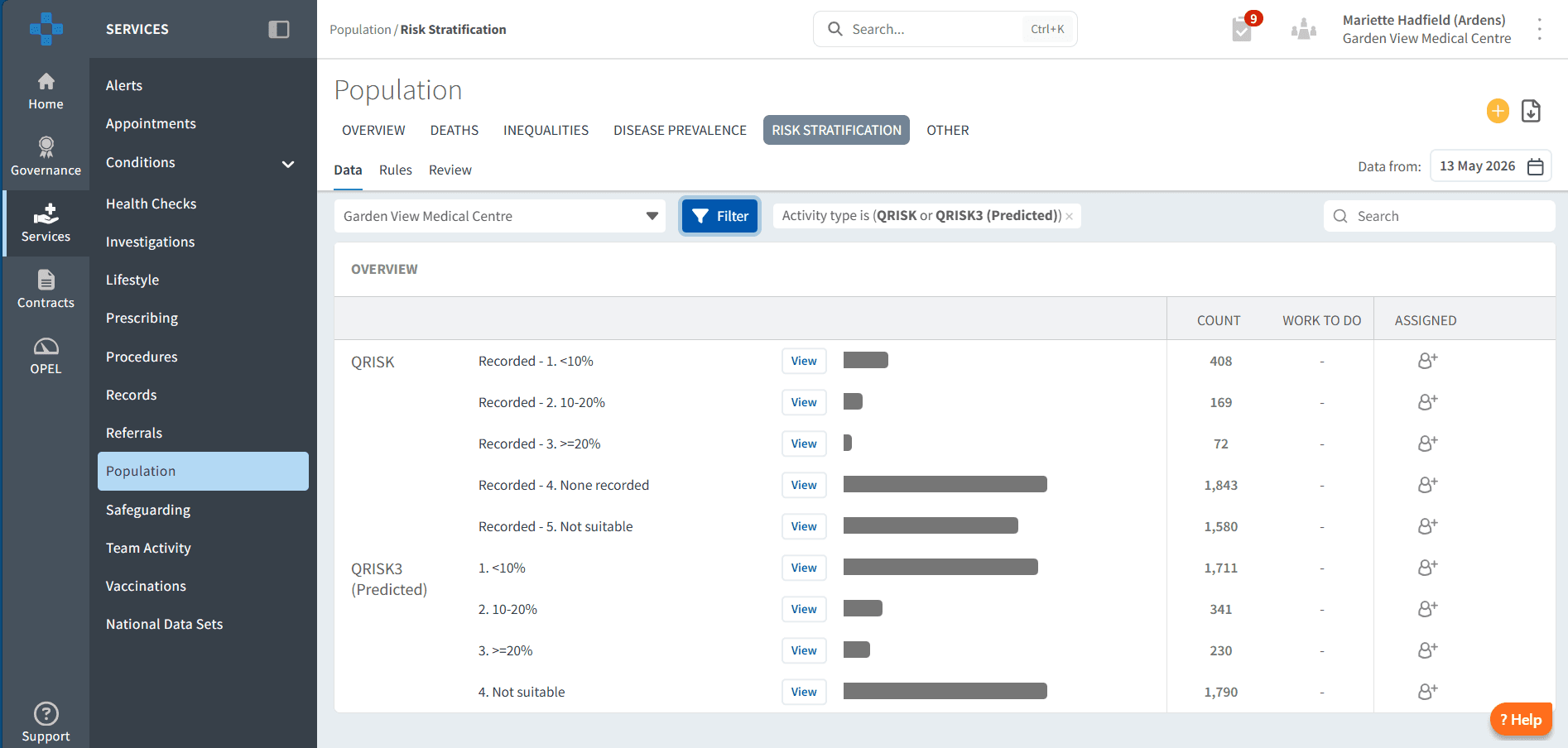
Population-level registers
Login to Ardens Manager
Select Services from the left-hand panel
Select the Population Dashboard
Select the Risk Stratification tab
Locate:
QRISK3® (Predicted)
QRISK2/3® (Recorded)
Use within reports
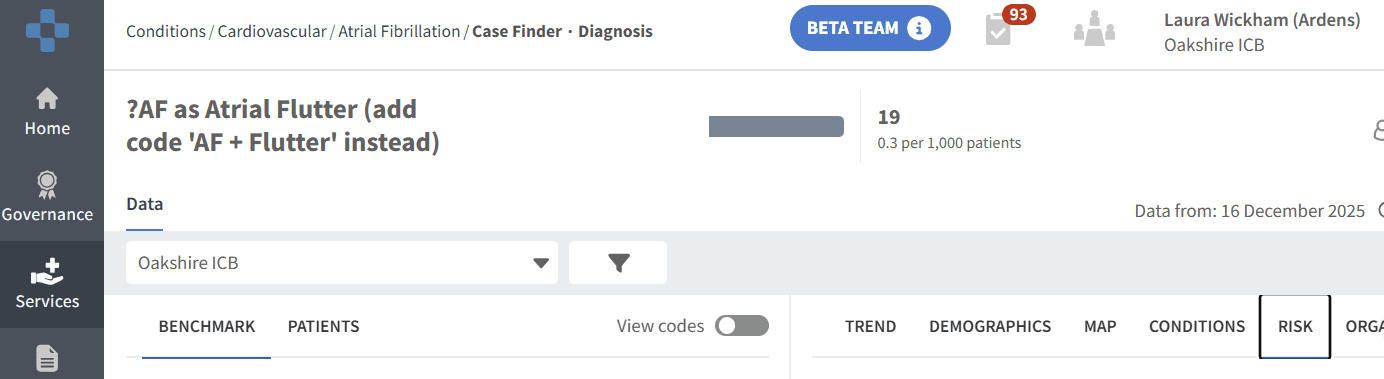
QRISK3® can also be applied within any report in Ardens Manager.
To access this:
Click View next to a report
Select the RISK tab
🏷️ Categories
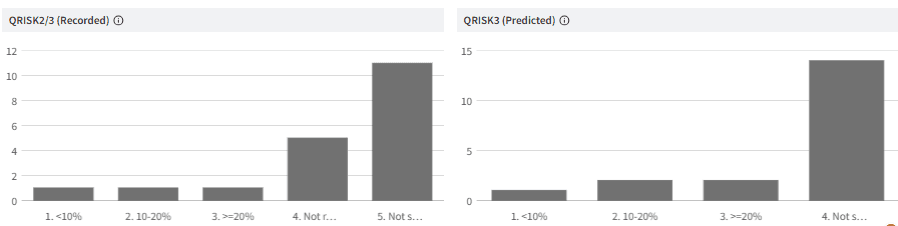
Patients are grouped according to their cardiovascular score.
Risk categories may include:
<10%
10–20%
≥20%
Not suitable / unable to calculate
These groupings help organisations identify patients who may benefit from cardiovascular review, preventative intervention, or lifestyle support.
🔎 Use Segmentation
Target patients within reports
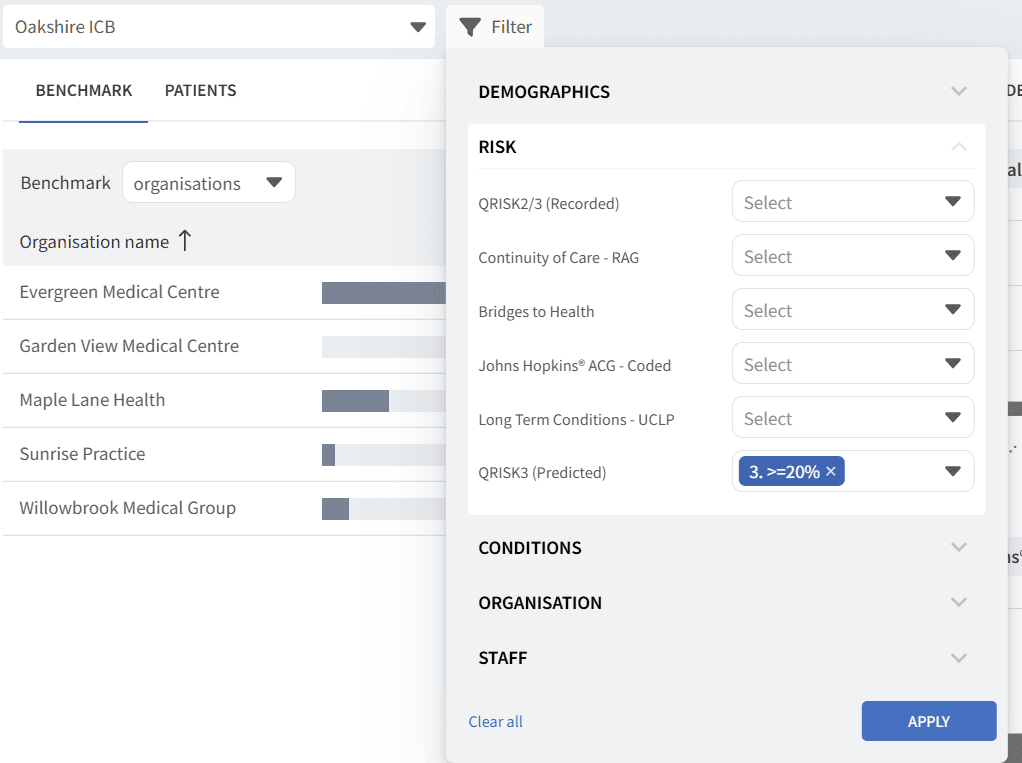
QRISK3® can be applied to any existing cohort to support prioritisation.
To access this:
Click View next to a report
Select the RISK tab
Open the Filter panel
Open the RISK section
Select either:
QRISK2/3 (Recorded)
QRISK3 (Predicted)
Choose the required category or categories
Click APPLY
This updates the report view to show data within the selected cardiovascular risk group.
Use this to:
Identify patients who may benefit from cardiovascular review
Support case finding and preventative care initiatives
Combine cardiovascular risk with clinical or operational reporting
Prioritise medication reviews or lifestyle interventions
Support MDT and population health management activity
Patient-level review
To view patient-level data:
Click View next to a report
Select the PATIENTS tab
Open Patient View for individual records
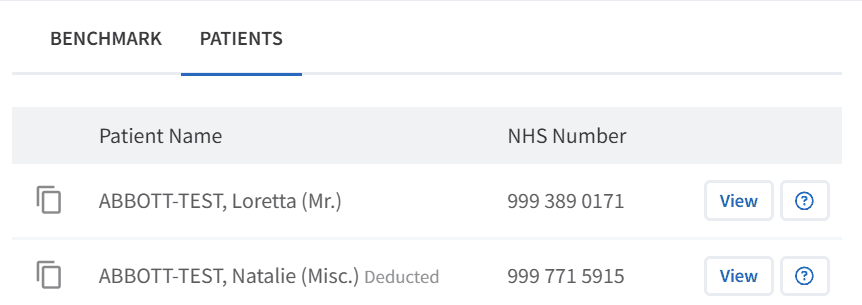
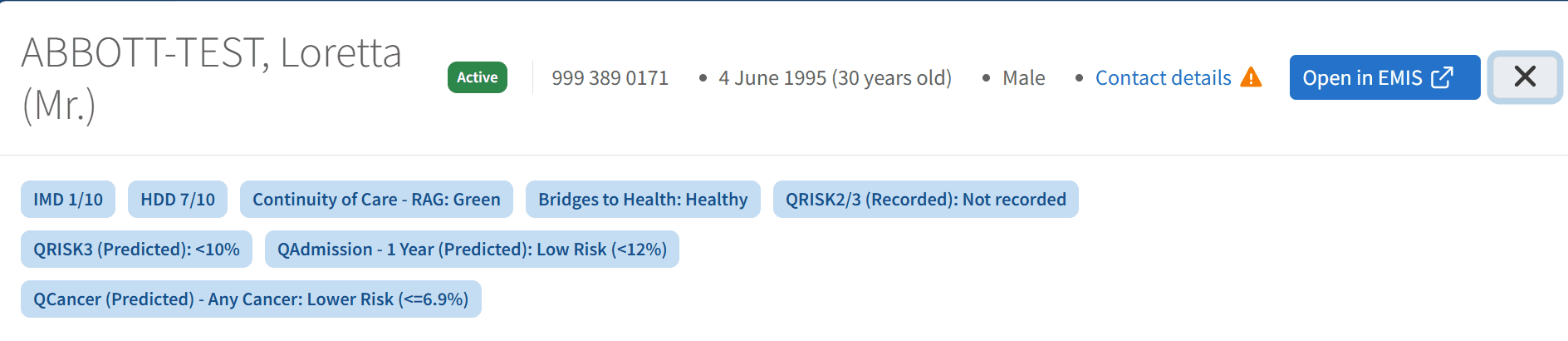
Within Patient View:
QRISK3 Predicted and Recorded information is displayed alongside other risk stratification tools
This allows comparison across multiple risk models
Supports targeted review and preventative care activity
⚠️ Key Considerations
QRISK3 is derived from coded clinical data
Accuracy depends on completeness and quality of underlying coding
Predicted QRISK3 scores are estimates only and should not replace formal clinical assessment
Recorded QRISK scores reflect clinician-confirmed assessments recorded in the clinical system
QRISK3 should support prioritisation and planning alongside clinical judgement
Risk status may change over time as patient information changes
🔒 Licencing & Disclaimers
QRISK® is a registered trademark of Egton Medical Information Systems Limited.
The initial version of the QRISK®3 algorithm is derived from source code available at:
QRISK Source Code
This code faithfully implements QRISK®3-2017 and has been released by ClinRisk Ltd under the GNU Lesser General Public License (LGPL) to enable others to implement the algorithm faithfully.
However, due to the nature of the LGPL:
It is not possible to prevent alterations to coefficients or logic
Inputs may be mis-handled or incomplete
Poor implementation may result in inaccurate scores
ClinRisk Ltd therefore state that:
It is the responsibility of the end user to ensure that any implementation produces results consistent with the original code
The reference implementation can be found at: QRISK Official Website
Inaccurate implementations of risk scores can result in patients receiving inappropriate treatment.
Ardens Manager presents QRISK3 outputs for informational and prioritisation purposes only and does not replace clinical judgement or validated point-of-care calculation.
License Disclaimer
The initial version of this file, to be found at Clinrisksvn.clinrisk.co.uk/opensource/qrisk2, faithfully implements QRISK3-2017. ClinRisk Ltd. have released this code under the GNU Lesser General Public License to enable others to implement the algorithm faithfully. However, the nature of the GNU Lesser General Public License is such that we cannot prevent, for example, someone accidentally altering the coefficients, getting the inputs wrong, or just poor programming. ClinRisk Ltd. stress, therefore, that it is the responsibility of the end user to check that the source that they receive produces the same results as the original code found at qrisk3.org. Inaccurate implementations of risk scores can lead to wrong patients being given the wrong treatment.
❓FAQs
What is the difference between Predicted and Recorded QRISK3?
Predicted QRISK3 estimates cardiovascular risk using available coded data where no recent recorded score exists. Recorded QRISK2/3 reflects a clinician-confirmed score recorded directly within the clinical system.
Can Predicted QRISK3 be used for clinical decision-making?
No. Predicted scores should be used to support prioritisation and population health management only. Any clinical decisions should be based on a validated clinical assessment and recorded QRISK score.
Can QRISK3® be used with other reports?
Yes, it can be applied as a filter across all Ardens Manager reports via the RISK tab.
Why might some patients show as unable to calculate?
This may occur where insufficient coded data is available to generate a risk estimate.
🏫 Additional Support
To further your understanding of the Ardens Manager platform:
Book training for your GP Practice, PCN or ICB.
Complete the Risk Stratification & Population Segmentation Academy module.
Contact our Support Team for support in real time.